

The Golden Era of Aerial Artistry: Brazil 2014
The 2014 FIFA World Cup in Brazil was an absolute masterclass in tournament football, defined by vibrant attacking play, shocking upsets, and exceptional goals. While thunderous volleys and dazzling dribbles often dominate the highlight reels, the tournament’s defining signature was written in the air. Time after time, world-class athletes defied gravity, attacking precise crosses and dead-ball deliveries with ruthless conviction to alter the course of footballing history.

Set-Piece Dominance and Tactical Breakthroughs
When open play was stifled by resilient backlines, set-pieces became the supreme equalizers. In knockout ties where spaces contracted and margins narrowed to razor-thin tolerances, towering headers broke the deadlock for tournament heavyweights:
- Paul Pogba vs. Nigeria: In a grueling Round of 16 battle, Vincent Enyeama had denied France for nearly 80 minutes. When Mathieu Valbuena swung in a corner, Pogba rose above the chaos to place a calm, deliberate header into the empty net, dismantling Nigeria’s heroic resistance.
- Mats Hummels vs. Portugal and France: Germany’s triumphant campaign was anchored by Hummels’ aerial dominance. Against Portugal, he leaped majestically to convert a Toni Kroos delivery, and he repeated the feat in the quarter-finals against France with a bullet header that sent Die Mannschaft to the semi-finals.
- Olivier Giroud vs. Switzerland: France showcased their aerial proficiency early in Group E when Giroud met Valbuena’s outswinging corner with immense power, squeezing the ball past Diego Benaglio to set the tone for a rampant French display.
Underdog Fairytales Written in the Air
Beyond the traditional superpowers, the 2014 tournament saw emergent nations command the airspace with sheer determination and split-second timing. Costa Rica’s fairytale march to the quarter-finals was sparked by aerial ingenuity. Against Uruguay, Óscar Duarte launched his body across the turf to connect with Christian Bolaños’ deep cross, scoring his first international goal. Days later against Italy, Bryan Ruiz met a looping cross to crash a header off the underside of the crossbar, vanquishing four-time world champions and sending Los Ticos into the knockout stages.

Similarly, Algeria demonstrated remarkable heading capability. Rafik Halliche’s thunderous header stunned South Korea, while Islam Slimani rose highest against Russia from a Yacine Brahimi free-kick, driving his country into the knockout phase for the first time in their history. In Group G, the United States found their savior in central defender John Brooks, who climbed high in the 86th minute against Ghana to head home a corner that sparked pure pandemonium.
Talismanic Strikers: Precision and Power
Heading at the elite level demands acute spatial awareness, anticipation, and supreme physical prowess. In Brazil, traditional center-forwards reminded the world why a lethal aerial presence remains irreplaceable:
- Mario Balotelli vs. England: Locked in a high-stakes duel in Manaus, Antonio Candreva fashioned yardage on the right wing and floated a sumptuous ball to the back post. Balotelli outmuscled his marker and produced an unstoppable downward header to secure victory for Italy.
- Luis Suárez vs. England: Returning from knee surgery, Suárez showcased world-class instincts when Edinson Cavani chipped a diagonal ball over England’s defense. Suárez met the ball at full stride, guiding an arching header past Joe Hart with devastating precision.
- Asamoah Gyan and André Ayew: Ghana pushed eventual champions Germany to the limit in a classic 2-2 draw. Ayew delivered an athletic leap over Germany’s defense, while Gyan later broke records to become Africa’s all-time top World Cup scorer with an emphatic headed finish against Portugal.
- Tim Cahill vs. Chile: Australia’s talismanic captain demonstrated his trademark hang time, soaring above defender Gary Medel to power home a header that reinforced his reputation as one of the game’s greatest aerial specialists.

The Flying Dutchman: An Eternal World Cup Masterpiece
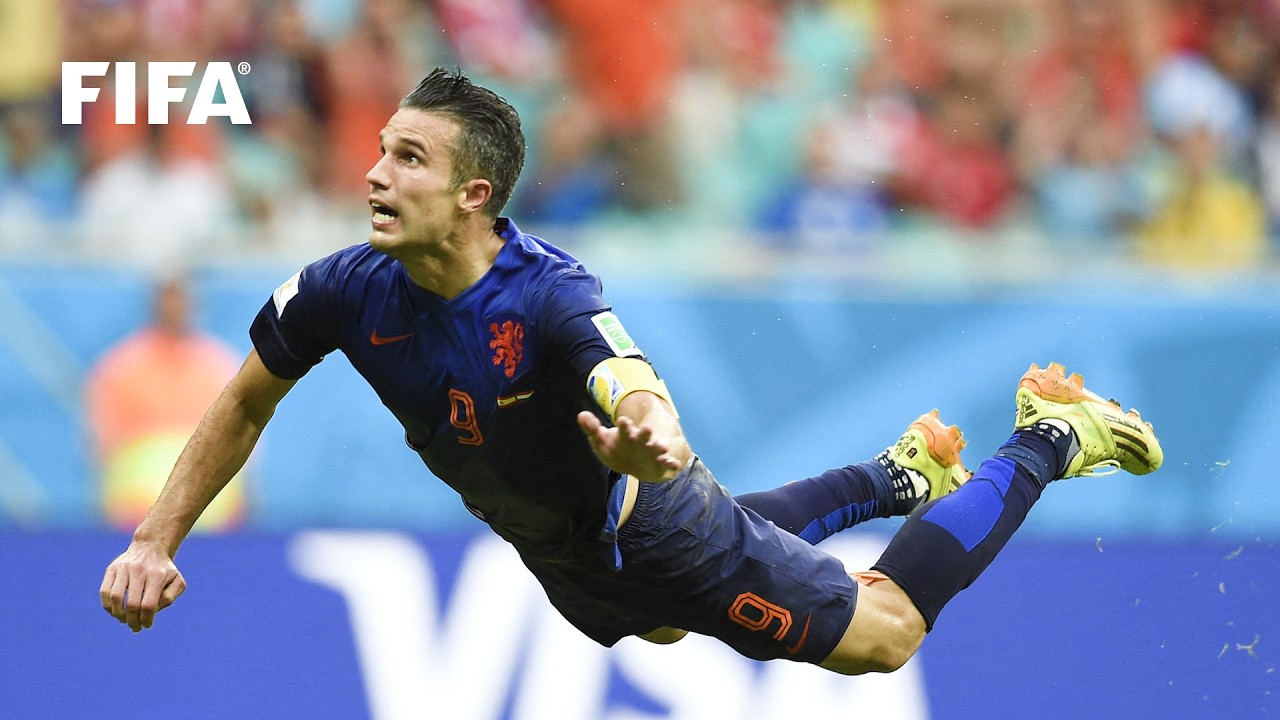
No discussion of headers at the 2014 World Cup is complete without Robin van Persie’s transcendent strike against reigning champions Spain. With the Netherlands trailing 1-0 just before halftime, Daley Blind unlocked the Spanish defense with a sweeping 45-yard diagonal pass. Spotting Iker Casillas stranded off his line, Van Persie made the audacious decision not to control the ball.
Instead, the Dutch captain took flight. In an astonishing display of coordination, Van Persie launched his entire body horizontally into the air, meeting the descending ball with a cushioned, looping header that sailed gracefully over Casillas and into the net. It was an instant classic—christened ‘The Flying Dutchman’—and remains the benchmark for aerial elegance on football’s grandest stage.
The Enduring Legacy of Brazil 2014
From Silvestre Varela’s 95th-minute headed equalizer for Portugal against the USA to Wilfried Bony’s rapid glancing headers for Ivory Coast, the headers of 2014 were not mere byproducts of direct football; they were dynamic tactical weapons. They required precise crossing from full-backs, supreme athletic timing from attackers, and nerves of steel. The tournament demonstrated that while modern football continues to evolve along the deck, the highest peaks of drama are still conquered in the air.

