
The Golden Era of the Long-Range Screamer
More than a decade later, the 2010 FIFA World Cup in South Africa stands apart in footballing history. It was a tournament defined by acoustic chaos, vibrant cultural pride, and a technological talking point that terrorized goalkeepers worldwide: the notorious Adidas Jabulani. Designed with cutting-edge supersonic bonding and an ultra-smooth profile, the ball dipped, knuckled, and swerved with ruthless unpredictability. While keepers beat the ground in despair, the world’s most fearless strikers turned chaotic aerodynamics into indelible sporting masterpieces.

Looking back across the tournament tape, the quality of strikes does not merely hold up—it gets progressively more jaw-dropping. Matches were decided not by cagey penalty shootouts or intricate passing triangles alone, but by players daring to pull the trigger from 30, 35, and even 40 yards out.
The Jabulani Tamer: Diego Forlán’s Masterclass
No discussion of 2010 screamers can begin without bowing to Diego Forlán. While almost every outfield player complained about the Jabulani’s flight dynamics during pre-tournament friendlies, Forlán reportedly spent weeks before the tournament practicing with the ball relentlessly. That diligence transformed him into a sniper throughout Uruguay’s thrilling journey to the semi-finals.
- The South Africa Stunner: Against the hosts in Pretoria, Forlán uncorked a long-distance strike that dipped violently under the crossbar, leaving the goalkeeper rooted to the turf and silencing the home crowd.
- The Ghana Free-Kick: In one of the most dramatic quarter-finals in modern memory, Forlán curled a venomous set-piece past Richard Kingson from a nearly impossible acute angle.
- The Dutch Equalizer: In the semi-final, picking up the ball between the lines, he shifted effortlessly onto his weaker left foot to whip a swerving missile into the top corner.
Forlán won the Golden Ball as the tournament’s best player, demonstrating that pure technique and tactical preparation could conquer any aerodynamic quirk.
Opening the Floodgates: Group Stage Fireworks
The group stages set a blistering benchmark for long-range drama. Group C kicked off with a moment of pure disbelief when Clint Dempsey tested England’s Robert Green with a hard, skidding drive from distance that squirmed agonizingly into the net. Later in the same group, Slovenia proved they could punch far above their weight: captain Robert Koren struck decisively against Algeria, and Valter Birsa delivered a sensational curling thunderbolt that left Tim Howard completely frozen.

Meanwhile, Asian powerhouses delivered a masterclass in direct dead-ball striking. In a crucial group showdown against Denmark, Japan unveiled a devastating one-two punch. Keisuke Honda blasted an audacious 35-yard dipping free-kick that left Thomas Sørensen helpless, only for Yasuhito Endō to repeat the trick minutes later with a textbook curling strike over the wall. Across the pitch, Korean talisman Park Chu-young added his own set-piece brilliance against Nigeria, proving that precision dead-ball striking was the tournament’s ultimate equalizer.
Knockout Stage Wonder Goals and Heartbreak
As the tournament progressed into the elimination rounds, the tension ratcheted up, yet players continued to unleash thunderous strikes on the biggest stages.
Carlos Tevez vs. Mexico
With Argentina battling fierce rivals Mexico in the Round of 16, Carlos Tevez produced what many consider one of the cleanest strikes in World Cup history. Collecting a loose ball 25 yards out, Tevez unleashed an absolute rocket that found the top corner before the keeper could even dive—lighting up Soccer City with pure South American flair.
Mesut Özil’s Laser vs. Ghana
A fresh, dynamic German squad found themselves in a must-win scenario against Ghana. Enter young Mesut Özil, who met a bouncing pass on the half-volley at the edge of the area and lashed a vicious, swerving left-footed screamer straight into the top corner, completely shifting the complexion of Group D.
Sulley Muntari’s Long-Range Shock
Moments before half-time in the pulsating Uruguay vs. Ghana quarter-final, Sulley Muntari lined up an optimistic strike from 35 yards out. The Jabulani swerved late through the crisp Johannesburg air, catching Fernando Muslera off-guard and giving Africa genuine hope of a historic semi-final berth.

The Crown Jewel: Giovanni van Bronckhorst’s 35-Yard Miracle
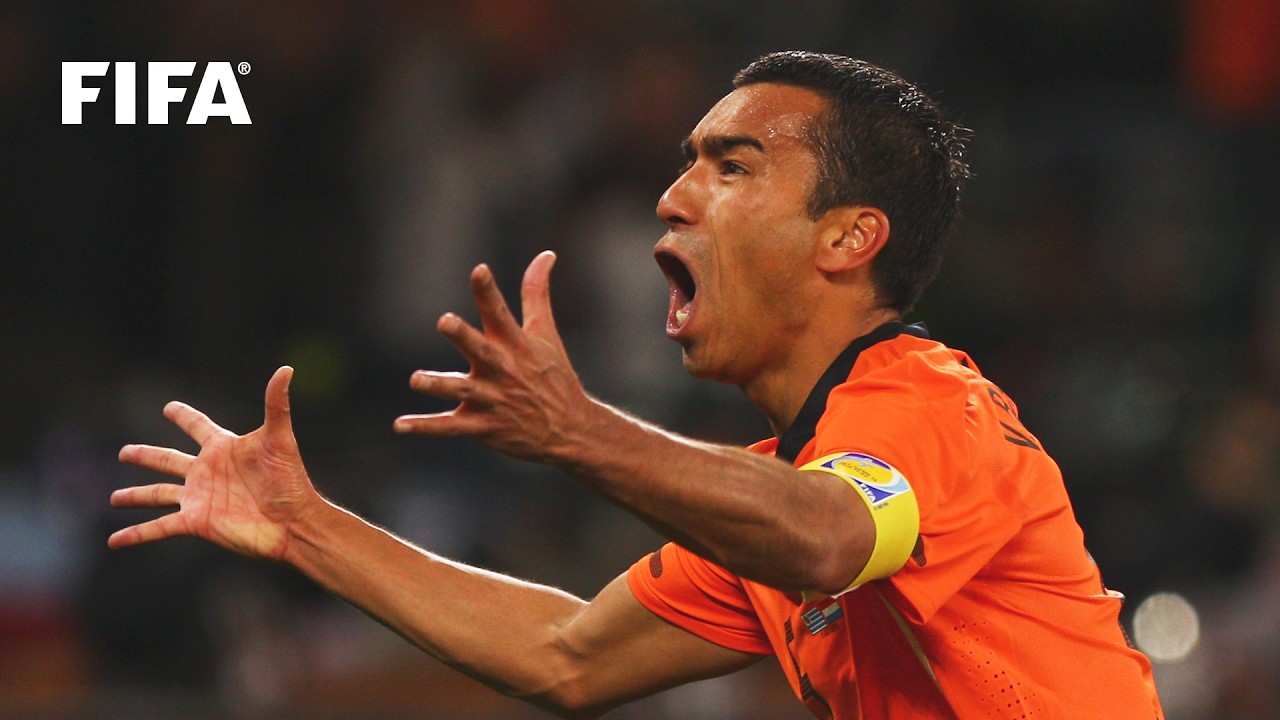
Every tournament has its signature goal, but the 2010 semi-final clash between the Netherlands and Uruguay delivered a moment of footballing immortality. In his 105th international cap and playing the twilight fixtures of his storied career, Dutch captain Giovanni van Bronckhorst picked up the ball out wide on the left flank, well beyond the penalty box.
With no obvious pass open, the 35-year-old fullback took a touch inside and unleashed a diagonal projectile of terrifying speed and precision. The ball clipped the far post at near-impossible velocity before nestling in the roof of the net. Even with modern high-speed cameras and frame-by-frame analysis, the strike looks almost synthetic in its trajectory—an unstoppable bullet that propelled the Oranje directly into the final.
Why 2010 Will Never Be Repeated
Modern tournament football has become increasingly streamlined: high pressing, low expected goals (xG) shot selection, and safe ball retention often deter players from gambling on 30-yard strikes. Furthermore, subsequent World Cup balls—such as the Brazuca and the Al Rihla—were engineered specifically to avoid the extreme dipping and erratic swerves characteristic of South Africa’s ball.
The 2010 World Cup captured lightning in a bottle. It rewarded audacious risk-takers, punished goalkeeping hesitation, and gifted the beautiful game a timeless highlight reel of strikes that truly continue to get better with every rewatch.