

The Dynamic Privacy Challenge in Large Language Models
As Large Language Models (LLMs) transition from static artifacts to dynamic, continuously updated systems, managing sensitive data has become one of AI’s greatest security challenges. In practice, models undergo continuous training, fine-tuning, preference alignment, and retrieval-augmented updates. Simultaneously, regulatory landscapes like GDPR and CCPA grant users the “right to be forgotten,” requiring model owners to handle data opt-outs and unlearning requests.
While standard privacy audits evaluate memorization in a fully static environment, real-world deployment is highly volatile. This article explores groundbreaking research from Northeastern University, the University of Washington, and other collaborators, revealing how adding or removing personal data in language model training triggers profound privacy “ripple effects.” These dynamics show that safeguarding Personally Identifiable Information (PII) is far more complex than simple data removal.
The Core Mechanics of Extractable Memorization
To study these privacy dynamics systematically, researchers must define how memorization is measured. Rather than focusing on “discoverable” memorization (prompting the model with exact prefix tokens from its training data), the research centers on extractable memorization.
Under this definition, an email address is considered extractably memorized if it appears in the model’s generation when prompted with a random string that is not part of the training data. This represents a worst-case security scenario, showing that an adversary does not need inside knowledge of the training corpus to leak PII.
Experimental Architecture
The research evaluated several prominent models, including:
- GPT-NeoX (1.5B parameters)
- Gemma (2B parameters)
- Llama 3 (8B parameters)
To simulate a sensitive data environment, the researchers embedded 16,000 unique email addresses from the Enron corpus at random positions within the WikiText-2 dataset. By placing emails randomly, they eliminated contextual dependencies, ensuring the model’s predictions were driven purely by memorization rather than contextual clues. Models were then prompted with 25,000 random 10-token strings from Common Crawl, generating 256-token outputs using both greedy decoding and top-k sampling.
Discovering ‘Assisted Memorization’
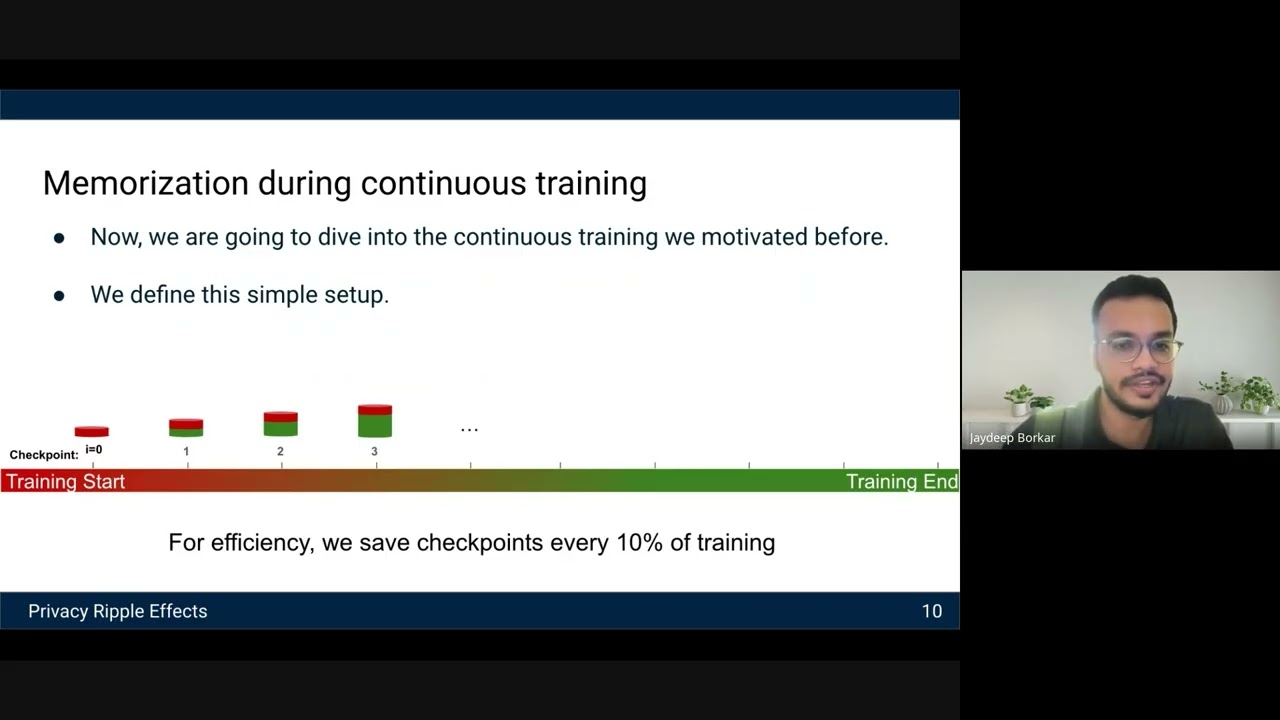
When fine-tuning a model on a dataset containing PII over multiple epochs, we naturally expect some emails to be immediately memorized, some to be retained, and others to be forgotten. By checkpointing the training process at regular 10% intervals, researchers mapped a new taxonomy of memorization:
- Immediate Memorization: PII is memorized immediately upon exposure in the training step.
- Retained Memorization: PII memorized in a previous step remains extractable in subsequent steps.
- Forgotten Memorization: PII that was once extractable becomes unextractable as training progresses.
- Assisted Memorization: A critical new category where PII is seen early in training but is not memorized immediately; instead, it becomes extractable only after the model trains on subsequent, completely different data.
Assisted memorization challenges the traditional assumption of “recency bias,” which suggests that data seen early in training becomes safer over time. In reality, early data remains highly vulnerable and can be “awakened” by later training phases.
The Culprit: Overlapping N-grams
Why does assisted memorization happen? Is it just delayed memorization? Through causal experiments, researchers ruled out simple delay. Instead, they discovered that assisted memorization is actively triggered by training on overlapping n-grams.
For example, if a model sees the email elizabeth.mccarthy@enron.com in Step 1 but doesn’t memorize it, subsequently training on related tokens in Step 2—such as “John McCarthy” or “Elizabeth”—strengthens the association pathways. The model leverages these overlapping fragments to reconstruct and leak the full, original email.
When researchers performed a causal intervention to remove overlapping 2-gram, 3-gram, and 4-gram tokens from subsequent training steps, the number of assisted memorized emails plummeted from 177 down to just 10. This confirms that partial duplicates and sub-token overlaps are primary drivers of privacy leaks.
Predicting Vulnerability via Machine Learning
To confirm the link between n-gram statistics and assisted memorization, researchers built a logistic regression model using features such as:
- Overlapping 2, 3, and 4-grams between emails and the training data.
- The frequency of last names in the training set.
- The frequency of domain names (e.g.,
@enron.com).
This simple model predicted which emails would experience assisted memorization with an impressive 93.7% precision and 87.4% recall, showing that statistical overlaps are highly reliable indicators of privacy risk.
The Ripple Effects of PII Opt-Ins (Adding Data)
What happens when new groups of users opt-in to have their data included, prompting the model owner to retrain the model with additional PII? The researchers modeled this by training ten successive models (M1 through M10), incrementally increasing the PII concentration from 10% to 100%.
They discovered two alarming trends:
- Super-Linear Leakage: Under top-k sampling, adding more PII causes a super-linear spike in overall extraction. For instance, the 50% dataset yielded 57 memorized emails, while the 100% dataset yielded 283—a nearly five-fold increase for a doubling of data.
- Increased Risk for Prior Data: Adding new PII dramatically increases the extractability of existing PII that was already in the model. The new data acts as an amplifying agent, exposing previously secure user information.
The ‘Privacy Onion’ Effect of PII Opt-Outs (Removing Data)
Conversely, what happens when users exercise their right to be forgotten and request data removal? To simulate exact unlearning, researchers repeatedly removed memorized emails and retrained the model from scratch on the scrubbed dataset.
This experiment revealed a layered memorization phenomenon, often referred to as the “Privacy Onion” effect:
- Layer 1: The original model leaks a set of emails (Set E1).
- Layer 2: Set E1 is removed, and the model is retrained. Suddenly, a new set of emails (Set E2) becomes extractable under the exact same prompts.
- Layer 3: Set E2 is removed and the model is retrained. A third set (Set E3) now leaks.
This recursive peeling continues for multiple rounds. The newly exposed emails in each round were already on the verge of memorization in the original model, hidden just beneath the surface. Removing the most dominant memorized examples lowers the training loss barrier, allowing the next layer of sensitive data to surface.
Analysis of model perplexity confirmed this: the emails extracted in later rounds clustered closely with the initially leaked emails, proving they were highly vulnerable from the start.
Key Hyperparameters Driving Privacy Risks
The study also identified critical system configurations that heavily influence PII extraction rates:
- Decoding Methods: Top-K sampling extracts significantly more PII than greedy decoding. This is because top-k sampling generates a wider variety of tokens, increasing the probability of hitting and reconstructing memorized sequences.
- Epoch Count and Prompt Type: While “extractable” prompting (using random prompts) and “discoverable” prompting (using exact context prefixes) yield similar leakage in early epochs, overtraining the model (up to 20 epochs) causes a massive divergence. Under extended training, discoverable prompting yields dramatically higher extraction rates.
Strategic Takeaways for AI Safety and Privacy Audits
This research fundamentally changes how we must approach privacy compliance and safety audits for generative AI:
- Evaluating only extracted examples is insufficient: Auditing only what currently leaks creates a false sense of security. Because of assisted memorization, data that seems safe today may easily leak tomorrow after minor downstream fine-tuning.
- Model scaling exacerbates the issue: As model sizes scale up (from GPT-2 variants to Llama-3 8B), the gap between assisted and immediate memorization grows. Larger models are far more efficient at utilizing overlapping n-grams to reconstruct early training data.
- Scrubbing requires holistic oversight: Simply removing requested PII is not enough. Privacy engineers must account for the “privacy onion” effect, ensuring that removing one user’s data does not inadvertently expose another’s.