

Introduction: The Challenge of Privacy in Modern Statistics
In the era of big data, extracting valuable insights while safeguarding individual privacy is one of the most critical challenges in computer science. Differential privacy (DP) has emerged as the mathematical gold standard for privacy preservation, but implementing it for fundamental statistical tasks—such as mean estimation, covariance estimation, and linear regression—often comes at a steep cost. Historically, developers and researchers have had to make hard trade-offs between computational efficiency, data utility, and sample complexity.
In a compelling presentation, Gavin Brown from the University of Washington detailed a series of groundbreaking papers co-authored with collaborators from Google. Their research introduces novel stable estimators that break through long-standing theoretical bottlenecks, enabling fast, private statistics without the crippling sample overhead traditionally associated with high-dimensional data.

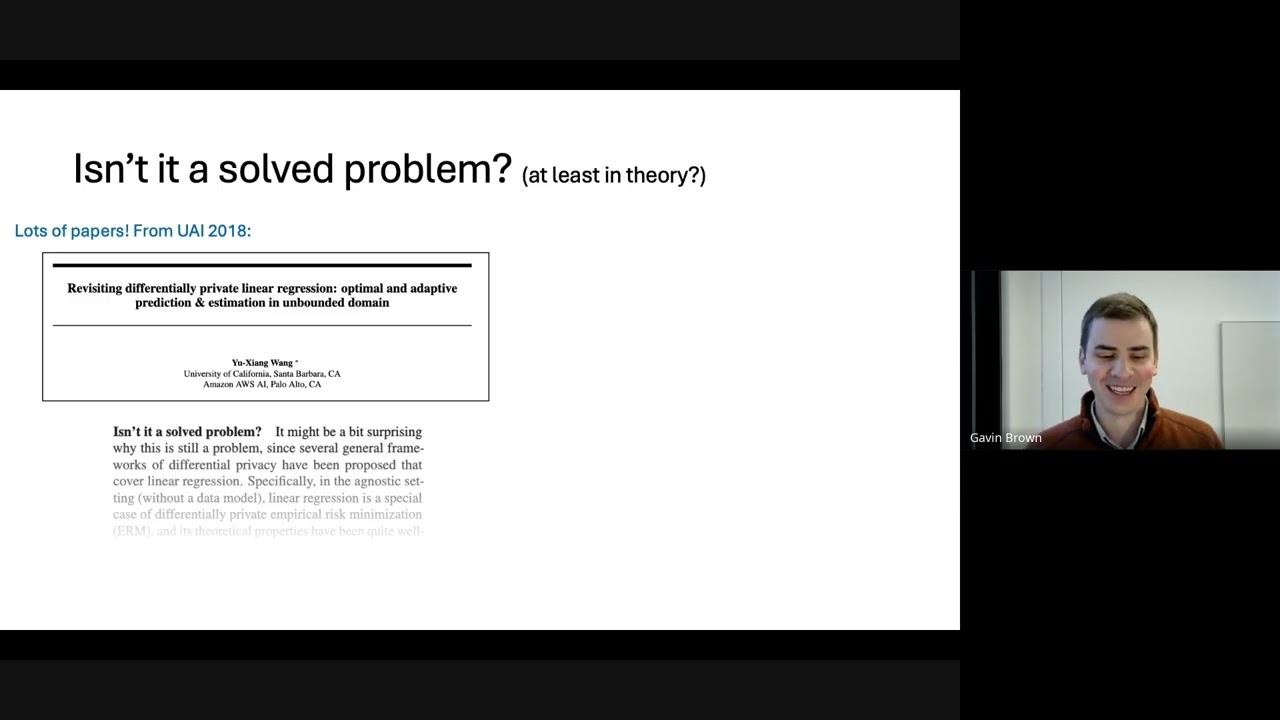
Why Linear Regression Wasn’t a “Solved” Problem in DP
At first glance, linear regression might seem like a solved problem. Classically, ordinary least squares (OLS) handles this task seamlessly in high dimensions, requiring a sample size that scales linearly with the dimension ($d$). However, enforcing differential privacy changes the landscape entirely. Prior to this work, all existing private estimators fell into at least one of three undesirable categories:
- High Sample Complexity: They required at least $d^{1.5}$ samples (far worse than the non-private $d$ baseline).
- Ill-Conditioned Sensitivity: Their error bounds depended heavily on the condition number of the covariance matrix, making them highly unstable on poorly conditioned data.
- Exponential Runtime: They relied on exponential-time mechanisms (like high-dimensional Proposed Test Release) to achieve optimal sample complexity.
This gap left practitioners with a frustrating dilemma. Standard techniques like Sufficient Statistics Perturbation (SSP) are computationally trivial but suffer from the $d^{1.5}$ sample complexity bottleneck because they require privatizing the entire covariance matrix. Conversely, optimization-based approaches like private gradient descent require extensive step counts and preconditioning, which again drags the sample complexity back up to the $d^{1.5}$ limit.
The Breakthrough: Insufficient Statistics Perturbation
Presented at the Conference on Learning Theory (COLT), Brown and his collaborators introduced a novel algorithm colorfully dubbed Insufficient Statistics Perturbation. This approach acts as a highly sophisticated variation of output perturbation, running in polynomial time (typically dominated by the time it takes to compute the non-private OLS solution) while maintaining spectacular accuracy guarantees on Gaussian data models.
Under this new framework, the error is split into two terms: the standard non-private error and an additive privacy error. Crucially, the privacy-induced error scales as $d^2 / n^2$. As the sample size ($n$) grows toward infinity, the privacy error shrinks rapidly, meaning that practitioners asymptotically get differential privacy “for free” without sacrificing accuracy.

The Secret Sauce: Redefining What Constitutes an “Outlier”
To achieve these bounds privately and efficiently, the authors had to fundamentally rethink how algorithms handle outliers. Traditional differentially private algorithms typically rely on bounding the $L_2$ norm of the data points. While simple to implement, $L_2$ clipping strips away crucial geometric structure, causing severe errors when data is poorly conditioned.
Instead, the research team turned to two classic statistical concepts: statistical leverage and residuals. In this context, an inlier is defined as a point with bounded leverage and a small residual. Leverage scores measure how much a single data point influences the overall rank of the data covariance matrix. If a point has high leverage, its removal could radically shift the OLS solution, making it a high-risk vector for privacy leakage.
The Stable Filtering Blueprint
The core of the new methodology is a stable filtering framework. The filtering algorithm takes in a dataset and outputs a weight vector (with weights between 0 and 1) for each data point. The framework guarantees three essential properties:
- Soundness: All high-leverage outliers are successfully removed or heavily downweighted.
- Completeness: If the dataset contains no outliers (which is highly probable when data is drawn from a well-specified Gaussian model), the filter does nothing, leaving all weights at 1.
- Stability: On adjacent datasets (differing by only a single element), the output weights remain extremely close in $L_1$ distance. This ensures that the filter itself does not leak sensitive information.
Deep Dive: The Greedy Leverage Filtering Algorithm
While proving stability is historically difficult because leverage scores are mutually dependent on the entire dataset, the authors designed a remarkably simple greedy algorithm to solve this. The filter works by iteratively computing leverage scores, throwing out elements exceeding a specific threshold, and recomputing.
To make the process stable, the algorithm runs this greedy filter across multiple exponentially scaled thresholds. By evaluating the dataset over a spectrum of tightening outlier boundaries, the algorithm creates “intertwined” level sets of data subsets. Because these subsets are structurally nested, the resulting weights shift smoothly and predictably even if an adversary changes a data point, satisfying the strict requirements of approximate differential privacy.

Future Horizons: Practical Constants and Optimization
While this research represents a major theoretical milestone, Brown concluded by looking toward the future. Currently, the mathematical proofs introduce somewhat large constant factors, meaning there is still a gap between theoretical optimality and day-to-day practical deployment on smaller datasets. Closing this gap by simplifying the proofs and refining the constants is an active area of exploration.
Furthermore, the stable filtering blueprint has massive potential beyond linear regression. Researchers are already looking to apply these exact leverage-filtering techniques to private Principal Component Analysis (PCA) and high-dimensional optimization, potentially enabling second-order optimization methods to run privately without the need for expensive covariance estimations. The era of fast, geometrically-aware private statistics has officially arrived.