

Introduction: The Shift to On-Device Intelligence
For years, deploying advanced artificial intelligence required massive cloud infrastructure, high-bandwidth connections, and substantial operational budgets. However, as applications demand lower latency, tighter privacy, and offline capabilities, the industry is pivoting toward edge AI. Google is leading this charge by combining lightweight open-weights models with high-efficiency hardware.

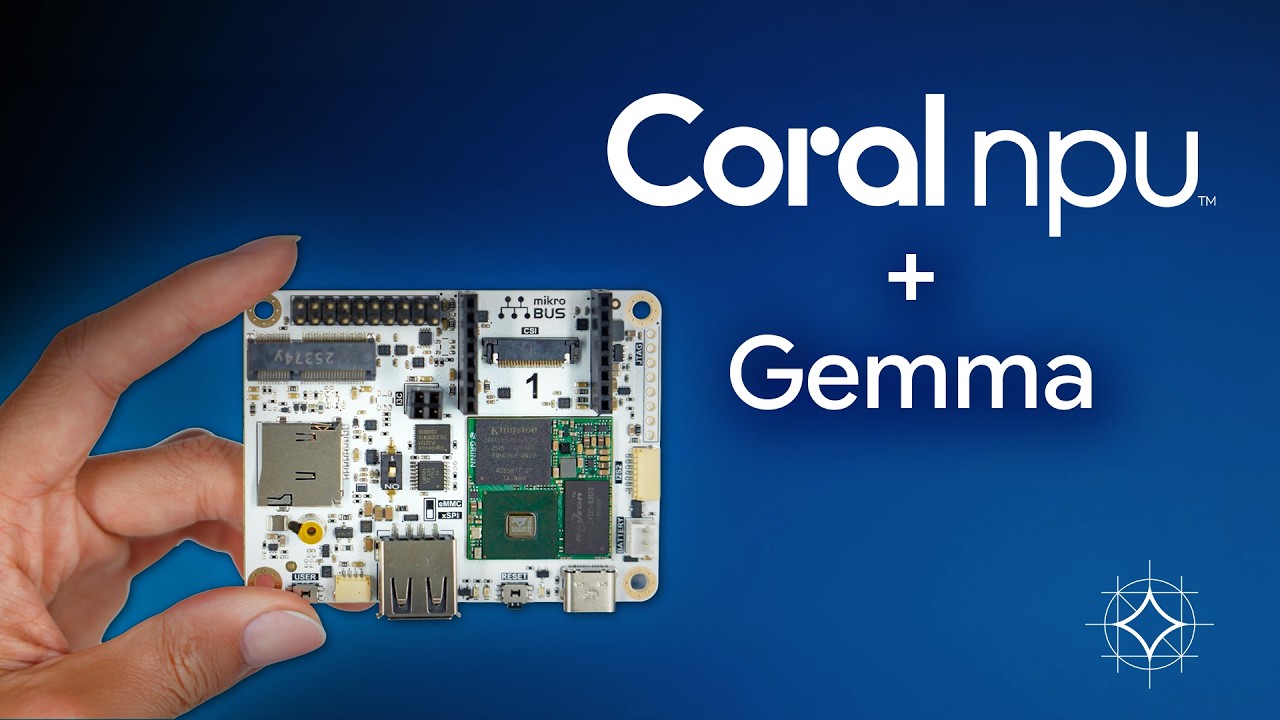
Enter the Coral Board. Engineered for developers, makers, and enterprise engineers alike, this small-form-factor development board is designed to bring local intelligence to embedded environments. Inside, it packs Google’s signature Coral MPU (Machine Learning Accelerator), providing the computational muscle needed to run Google’s state-of-the-art Gemma model entirely on-device, without sending a single byte of data to the cloud.
Unpacking the Hardware: Built for the Edge
The Coral Board is designed from the ground up to address the unique constraints of edge computing: power efficiency, thermal management, and compact physical dimensions. Despite its small footprint, it provides a comprehensive hardware ecosystem. To facilitate rapid prototyping, Google has packaged the board into a comprehensive developer kit that includes:
- Google Coral MPU: Dedicated machine learning silicon designed for fast, low-power inference.
- Sensor Suite: Integrated cameras and dual-microphone arrays for vision and audio input.
- User Interface Elements: An on-board screen and programmable LEDs to provide instant feedback.
- I/O Expansion: Rich general-purpose input/output (GPIO) pins to interface with external actuators, sensors, and legacy hardware.

What Can You Build? Real-World Demos Running Locally
By bringing Gemma—Google’s family of lightweight, state-of-the-art open models—to the Coral hardware, developers can achieve incredibly low-latency interactions. Because the entire LLM pipeline runs locally, there is no network latency, subscription fee, or data privacy risk. During Google I/O, several groundbreaking demos showcased what this hardware-software integration is capable of:
1. Offline Speech-to-Speech Translation
The Coral Board can capture spoken words via its integrated microphone, process the speech, translate it to another language using the local Gemma model, and speak the translation back in real-time. This opens up massive opportunities for offline translation devices used in remote areas, emergency response, or highly secure facilities.
2. Natural Language Physical Control
Instead of writing complex, rigid state-machines to control physical hardware, developers can use Gemma to interpret natural language commands. A user can speak conversational instructions to the board, and Gemma will parse the intent and trigger the GPIO pins to toggle physical switches, control motors, or adjust lighting.
3. Multimodal Creative Experiences
Edge AI isn’t just utilitarian; it is also highly creative. In one of the most unique demonstrations, developers utilized vision input to generate music dynamically. By monitoring an aquarium of jellyfish via the on-board camera, Gemma and the Coral MPU analyzed the movement and translated those organic visual patterns into a synthesized audio soundscape, proving that complex multimodal sensor fusion is entirely feasible on a single, pocket-sized device.

Open Source and Ready for Innovation
True to Google’s commitment to open-source development, all of the reference applications and demos shown—including the translation pipelines and the creative multimedia installations—are open-sourced on GitHub. Developers can dissect the code, understand the model quantization techniques used to fit Gemma onto the MPU, and deploy their custom models with ease.
The open-hardware design philosophy of the Coral ecosystem ensures that as your project scales from a prototype to a commercial product, the transition path is well-supported. The Coral Board will be widely available this summer, representing a major step forward in democratizing highly capable, localized AI for the global developer community.