

The Anatomy of pressure: Why Quarter-Final Goals Define Football History
In the high-stakes arena of the FIFA World Cup, the Quarter-Finals serve as a brutal filter. It is the stage where the romantic optimism of the group stages and the frantic energy of the Round of 16 collide with cold, tactical reality. For analysts, sports scientists, and fans alike, this round produces a unique strain of magic: goals that are not just athletically spectacular, but tactically revolutionary. When the margins of error shrink to near-zero, the world’s finest athletes rely on a combination of muscle memory, spatial intelligence, and raw, instinctual genius to break the deadlock.

The Masterclass of Movement and Positioning
Before analyzing the technical marvels of solo runs and long-range free kicks, we must appreciate the genius of spatial exploitation. The legendary Italian striker Paolo Rossi provided a masterclass in this during Italy’s iconic 1982 clash against a heavily favored Brazil. Rossi’s hat-trick was not built on physics-defying long shots, but on micro-movements inside the penalty box.
- The Opener: Capitalizing on a pinpoint cross from Cabrini, Rossi utilized blind-side running to escape his marker, heading home to break his international drought.
- The Opportunist: Intercepting a lazy lateral pass across the Brazilian backline, Rossi demonstrated elite acceleration, pouncing on the defensive error with lethal efficiency.
- The Decider: Standing in the crowded six-yard box, Rossi remained completely static until the ball was deflected, using his lightning-fast reaction time to redirect the ball past the keeper.
Similarly, in 1994, Brazil’s Romário showcased the “fox in the box” archetype. By constantly shifting his weight and utilizing subtle body feints, he occupied the attention of multiple defenders, creating space for himself to execute a classic, instep volley that left the goalkeeper stranded. These goals demonstrate that high-performance football is often won in the inches of space created before the ball even arrives.
Individual Genius and Physics-Defying Mastery
Sometimes, tactical systems are utterly dismantled by sheer individual will. The most famous example of this in football history occurred in 1986, courtesy of Diego Maradona against England. While his “Hand of God” goal is infamous, his second goal in that quarter-final remains the gold standard of individual genius.
Receiving the ball in his own half, Maradona turned past two defenders with a subtle pirouette, accelerated into open space, and embarked on a 60-yard slalom. By maintaining a low center of gravity and utilizing micro-touches with his left foot, he manipulated the defenders’ positioning, forcing them to overcommit before rounding Peter Shilton. It was a masterclass in kinetic control and ball retention under extreme pressure.

Fast forward to 2002, and another Brazilian magician, Ronaldinho, defied expectation in a moment of pure audacity against England. Facing a free-kick from an incredibly acute angle, conventional football wisdom dictated a cross into the box. Instead, Ronaldinho analyzed David Seaman’s aggressive positioning. Spotting the English keeper slightly off his line, Ronaldinho struck a looping, dipping effort that sailed directly into the far top corner. Whether it was a cross-turned-shot or a calculated masterpiece, it remains one of the most intellectually daring goals in tournament history.
Tactical Chess and Set-Piece Innovation
Modern football is increasingly defined by meticulously rehearsed set-piece routines. When open-play opportunities are choked by rigid defensive low-blocks, managers turn to innovative engineering to unlock defenses. The 1994 World Cup was a golden era for this type of tactical variation.
Sweden’s Thomas Brolin scored a brilliantly worked goal against Romania that looked straight out of a playbook. While the Romanian wall braced for a powerful, direct shot from Stefan Schwarz, Brolin darted from behind the wall as Håkan Mild ran over the ball. A delicate, disguised pass slipped Brolin through on the right, allowing him to smash the ball into the roof of the net. The entire defensive unit was caught completely off guard.
This tactical deception reached its absolute zenith in the 2022 World Cup during the dramatic encounter between the Netherlands and Argentina. Trailing deep into stoppage time, the Dutch won a free-kick on the edge of the box in the 101st minute. Instead of shooting over the wall, Teun Koopmeiners played a disguise pass directly through the defensive line to Wout Weghorst, who controlled the ball on the turn and slotted it home. It was a high-risk, high-reward routine executed with surgical precision under maximum psychological pressure.
The Art of the Perfect First Touch
No discussion of legendary quarter-final goals is complete without analyzing the biomechanical perfection of Dennis Bergkamp‘s goal against Argentina in 1998. With the game tied 1-1 in the 89th minute, Frank de Boer launched a sixty-yard diagonal pass over the Argentinian defense.
What followed was three seconds of pure athletic perfection:
- The Take Down: Bergkamp leaped and deadened the high-velocity ball with the instep of his right foot, matching the ball’s speed perfectly to keep it within his playing radius.
- The Turn: In a single, fluid motion, he used his second touch to flick the ball inside the recovering defender, Roberto Ayala, completely neutralizing the defender’s momentum.
- The Finish: With his third touch, Bergkamp struck an outside-of-the-boot shot into the far corner past Carlos Roa. It was a sequence that combined elite physics, spatial awareness, and clinical execution.

Conclusion: The Everlasting Legacy of Quarter-Final Drama
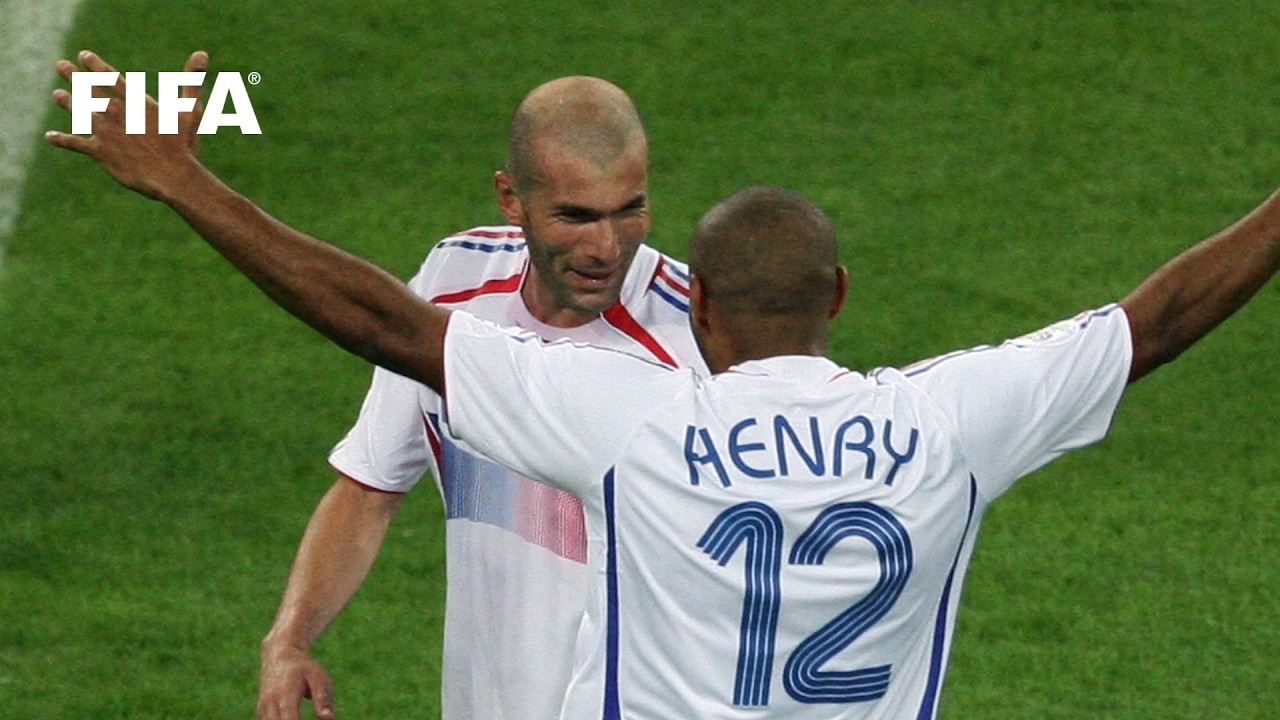
From the physical dominance of Romelu Lukaku setting up Kevin De Bruyne’s laser-like strike against Brazil in 2018, to Thierry Henry’s back-post volley from a flawless Zinedine Zidane delivery in 2006, the World Cup Quarter-Finals consistently showcase the absolute pinnacle of footballing excellence. These goals endure because they are not mere statistics; they represent the perfect convergence of physical preparation, tactical innovation, and the unpredictable beauty of human genius. As technology continues to evolve and reshape sports science, the core of the game remains unchanged: a single moment of brilliance can rewrite history forever.