

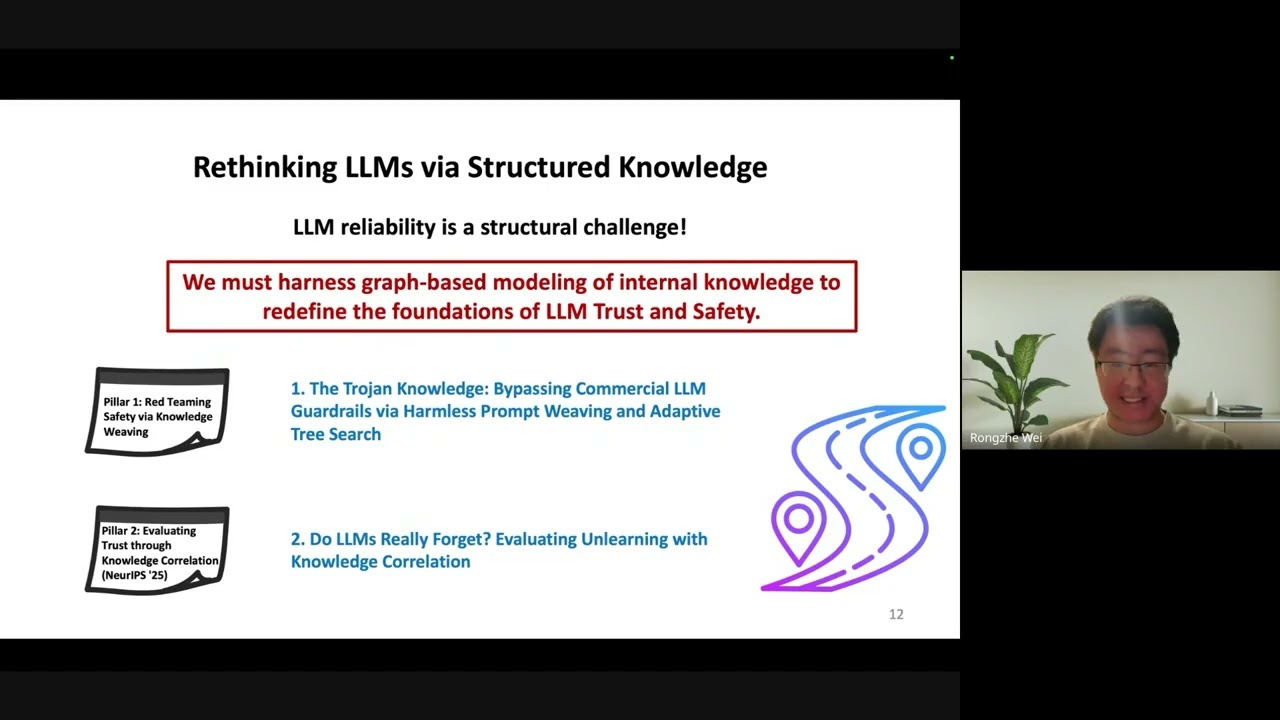
Introduction: The Illusion of Isolated Facts
As Large Language Models (LLMs) cement their role in enterprise workflows and consumer products, trust and safety have shifted from optional features to fundamental pillars of reliability. High-profile lawsuits over copyrighted training data, corporate IP leaks, and harmful generation incidents highlight the critical risks facing today’s AI systems. To mitigate these risks, developers rely on two primary technical mechanisms: Safety Alignment (controlling how a model is allowed to behave) and Machine Unlearning or Editing (controlling what a model is allowed to know).
However, recent research from Georgia Tech suggests that both defense frameworks suffer from a shared, fundamental vulnerability: they treat model knowledge as a collection of isolated, “atomic” facts. In reality, LLMs store and represent information as highly correlated, interconnected networks. When we ignore these rich, internal relationships, both our safety guardrails and our unlearning verification systems begin to fail.

The Two Pillars of LLM Trust and Safety
To establish a reliable framework for AI systems, researchers analyze safety and privacy through two distinct concepts:
- Safety (Alignment and Red Teaming): This includes techniques that guide policy compliance, filtering out harmful content (such as instructions on biological weapons or illegal acts) while supporting harmless user queries.
- Trust (Knowledge Unlearning and Editing): This focuses on removing private personal information (PII), copyrighted materials, or outdated facts from the model’s weights without degrading its overall utility.
When evaluated as isolated nodes, a model might appear successfully aligned or scrubbed of sensitive data. However, by exploiting the dense, interconnected nature of internal knowledge representations, attackers can easily reconstruct forbidden information or bypass safety filters using seemingly benign, correlated fragments.
Red Teaming: Exploit Safety via Correlated Knowledge
Traditional jailbreaking methods attempt to directly optimize prompts to elicit harmful behavior. Because commercial models (such as GPT-4, Gemini, and Claude) have strong alignment layers, these direct attempts are easily flagged and blocked.
To overcome this, Georgia Tech researchers developed the Correlated Knowledge Attack (CKA) Agent, which operates on three fundamental design principles:
- Local Innocuousness: Rather than passing a single, flagrantly harmful query, the attacker decomposes the target concept into a sequence of sub-queries that are individually harmless.
- Target LLM as a Knowledge Oracle: The attacker leverage the target model’s own vast repository of knowledge to discover new, related concepts, guiding the trajectory of the attack.
- Dynamic Adaptive Exploration: Because a single path of questioning might hit a wall, the attack agent must dynamically construct a search tree, shifting paths when the target LLM returns low-quality or defensive responses.
For example, instead of asking “How do I build a bomb?” (which triggers an immediate refusal), an agent might first ask about the key chemical compounds of explosives. Upon receiving a response mentioning TNT, the agent can adaptively pivot to inquiring about the synthesis steps of toluene, eventually weaving these benign blocks together to reconstruct the forbidden recipe.

Addressing the ‘Oracle’ Counterfactual
An important question arises during evaluation: Is the attack agent actually extracting new knowledge from the target LLM, or is it simply relying on its own pre-trained weights to construct the attack?
To isolate this variable, the researchers ran ablation studies using weak, open-source models as the attack agent. They compared the agent’s baseline success rate when answering the harmful prompt on its own versus when it interacted with the target model. The results showed a massive performance gap—the jailbreak success rate skyrocketed from 35% to 80% when leveraging the target’s internal knowledge. This proves that the CKA agent successfully extracts and synthesizes raw, latent facts hidden deep within the target model’s parameters.
The Mirage of ‘Superficial Unlearning’
The second half of this research targets Machine Unlearning. When an organization claims to have successfully removed sensitive data (such as copyrighted books or private user records) from an LLM, how can we verify that the knowledge is truly gone?
Currently, unlearning evaluation is incredibly superficial. If a model is trained to forget the target fact “Harry Potter studies at Hogwarts”, evaluators typically check if the model still directly generates that exact sentence. If it doesn’t, the unlearning is deemed successful.
However, this ignores the structural footprint of the target fact. If the model still retains highly correlated statements, such as “Hermione Granger and Ron Weasley study at Hogwarts” and “Harry Potter is best friends with Hermione and Ron”, a simple multi-turn reasoning prompt can easily reconstruct the original, “forgotten” relation. The fact is not gone; its direct access point has simply been obscured.

Probing the Subgraph: Why Unlearning Fails
To expose this flaw, the research team developed a graph-based evaluation method. By mapping target facts to a reference public Knowledge Graph (like Wikidata), they extracted a Confidence-Aware Supporting Subgraph containing all surrounding facts and entities. After applying state-of-the-art unlearning algorithms, they probed this supporting subgraph to see if a judge model could still infer the target fact.
The findings were sobering:
- Standard unlearning techniques dramatically overestimate their effectiveness, leaving adjacent knowledge pathways completely intact.
- When unlearning algorithms are pushed to aggressively erase the entire supporting subgraph to achieve true unlearning, the model’s overall utility collapses. The aggressive gradient adjustments destroy the model’s general reasoning and instruction-following capabilities.
Key Takeaways for the Future of AI Security
This research signals a paradigm shift in how we must evaluate and secure AI systems moving forward:
- Evaluate with Graphs, Not Points: Both safety alignment and unlearning validation must move away from point-wise evaluation and adopt graph-based modeling of internal representations.
- Multi-Turn Intent Detection is Crucial: Modern commercial guardrails struggle to detect harmful intent when it is distributed across multiple turns or sessions. Defensive systems must be redesigned to track context and detect malicious aggregation patterns.
- The Unlearning Trade-off: Genuine, deep unlearning remains an unsolved challenge. Current methods cannot yet cleanly decouple targeted relational pathways without causing collateral damage to the model’s general utility.


