

The Human Bottleneck in Software Development
For decades, the trajectory of software development has been defined by a fundamental mismatch: while our hardware capabilities and codebase sizes scale exponentially, the human brain remains stubbornly finite. Software engineers struggle to juggle more than seven concepts in active memory at once. To build and maintain systems spanning hundreds of thousands—or millions—of lines of code, our minds must constantly swap concepts in and out. The primary bottleneck in software engineering is not compiler technology, execution environments, or programming languages; it is the cognitive limit of our minds.
While artificial intelligence promises to challenge these limitations, it introduces a new paradox. Large Language Models (LLMs) can generate boilerplate, write functional code, and translate syntax instantly, but they also hallucinate, inject subtle bugs, and struggle with high-level architectural complexity. Today’s developers must master a new art: maintaining intellectual control over increasingly complex systems. This is the core focus of Code Health Guardian, a philosophy designed to help teams conquer software complexity, maintain cognitive control, and build sustainable software in the AI era.
The Knowledge Feedback Loop: From the Industrial Revolution to AI
To understand the current state of software engineering, we must look at how humanity historically managed knowledge. The 2025 Nobel Prize in Economics highlighted the work of economic historian Joel Mokyr, who demonstrated that sustained economic growth requires a special relationship between two types of knowledge:
- Prescriptive Knowledge (Practice): Knowing what to do. This represents techniques, methodologies, and raw application.
- Propositional Knowledge (Theory): Understanding why things work. This represents the underlying science, mathematics, and logic.
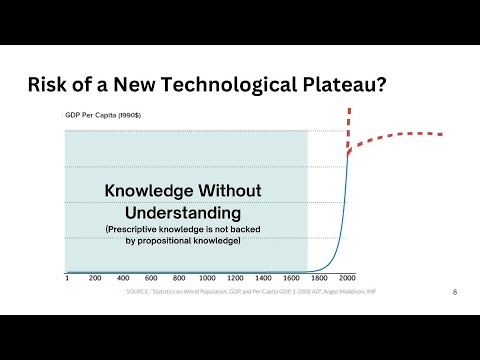
Mokyr argued that for millennia, human history remained on a technological plateau because practice and theory were disconnected. Ancient civilizations constructed massive, impressive structures, yet they practiced metallurgy without chemistry and mining without geology. They possessed practical knowledge without genuine understanding.
Permanent growth only became possible during the Industrial Revolution when these two domains merged into a continuous knowledge feedback loop: theory made practice more systematic, and practice pushed theory to evolve.
The Risk of the AI-Era Plateau
The rise of LLMs mirrors this historical tension. LLMs represent a massive repository of prescriptive knowledge, yet they lack genuine, underlying propositional understanding. If developers fall into the habit of blindly accepting AI-generated outputs without digesting the underlying logic, we risk breaking our industry’s knowledge feedback loop and sliding backward into a pre-industrial style plateau.
Conversely, if leveraged correctly, AI can scale propositional knowledge horizontally. It can explain complex software theories on-demand using a developer’s specific, practical codebase as context. In this new era, the human’s primary role shifts from generating code (the how) to validating architecture and managing complexity (the why).
Is Code Complexity Objective or Subjective?
Historically, software development has been treated as a subjective craft. We argue endlessly in code reviews about aesthetics, patterns, and structure. However, code health is mostly objective. At its core, code is either structured in a way that is easily understandable and maintainable, or it is not.
John Ousterhout, author of A Philosophy of Software Design, established a foundational complexity model, arguing that complexity is driven by two main causes: obscurity and dependencies. These causes manifest as three distinct problems in a codebase:
- Unknown Unknowns: When you need to make a change, but you do not have all the facts, leading to unexpected regressions. This is the most severe and dangerous software complexity problem.
- Cognitive Bloat: When the code requires a massive amount of mental effort to understand, even if no errors are made.
- Change Amplification: When a simple modification forces you to touch code in many different, seemingly unrelated places.
The 7 Strictly Negative Complexity Causes
To make Ousterhout’s model more actionable, we can decompose the vague concept of “dependencies” into more specific, negative causes of complexity:
- Too many dependencies
- Unstable dependencies
- Untrue or misleading interfaces
- Chronological obscurity (ordering dependencies implicitly)
- Cognitive load (over-engineered structures)
- Unfamiliar syntax or design patterns
- Leaky abstractions
By identifying these specific causes, teams can systematically audit and reduce complexity. AI plays a massive role in mitigating the subjective elements of this list: it can explain unfamiliar syntax and lower cognitive load, allowing developers to focus on fixing objective architectural flaws.
Practical Paradigms for Code Health
1. Embracing Semi-Functional Programming and Immutability
One of the easiest ways to eliminate chronological obscurity and leaky state changes is by writing semi-functional code and enforcing immutability by default. Immutable objects cannot be modified after creation, which prevents side effects and eliminates entire classes of bugs. While immutability was historically rejected due to cognitive overhead and performance concerns, modern systems and compiler optimizations make it a highly practical approach for general-purpose programming.
2. Re-evaluating the DRY Principle
The DRY (Don’t Repeat Yourself) principle is a staple of software engineering. However, blindly applying DRY can lead to over-abstraction and tight coupling.
When you duplicate code, you introduce the risk of change amplification. However, you can neutralize the more dangerous “unknown unknowns” problem by leaving explicit comments in both places that link to one another. If duplicating a small block of code avoids an overly complex abstraction, accept the duplication and mitigate the risk with clear, linked comments or pre-commit automated checks.
3. The Mathematics of Deep Interfaces
How do we design clean modules? We can think about interface depth mathematically:
Interface Depth = Functionality / Interface Complexity
A deep interface offers massive functionality through a very simple, intuitive boundary. A classic example is a runtime garbage collector: it provides an incredibly simple interface (typically zero configuration) but delivers massive, complex functionality (managing all system memory). When designing classes and APIs, aim to maximize this ratio by hiding implementation details and exposing simple, high-leverage entry points.
Processes That Guard Code Health
Healthy code does not exist in a vacuum; it starts with collaborative processes outside of the editor.
Design Docs & Trade-off Tables
Design documents are the ultimate tool for trade-off analysis. Instead of relying on long prose and lists of pros and cons, software architects should utilize trade-off tables. Originally popularized in deep technical documentation (such as Google Spanner’s comparison guides), trade-off tables compare multiple design options across a static set of requirements. This structure makes the trade-offs visual, highly objective, and entirely clear.
The 4 True Goals of Code Reviews
Most development teams limit the scope of code reviews to two basic functions: improving product quality and sharing knowledge. In reality, a high-performing code review process must balance four critical goals:
- Quality: Ensuring the code meets style, performance, and architectural guidelines.
- Knowledge Sharing: Spreading domain expertise across team members.
- Speed: Prioritizing fast turnarounds to prevent code reviews from becoming operational bottlenecks.
- Trust: Treating the review as a tool for psychological safety and peer trust rather than a punitive gate.
Conclusion: The Evolving Role of the Human Engineer
The transition into the AI era does not diminish the need for human software engineers; it elevates our responsibilities. We are no longer mere code generators; we are the guardians of code health. By understanding propositional software science, utilizing objective complexity models, and implementing robust collaborative processes, we can ensure our systems remain robust, understandable, and prepared for future innovation.


