

The Rise of the Blue Samurai: Analyzing Japan’s Iconic World Cup Goals (1998–2010)
For decades, international football was dominated by the traditional powerhouses of Europe and South America. However, the turn of the millennium witnessed the spectacular rise of Asian football, spearheaded by the Samurai Blue. Japan’s journey from World Cup debutants in 1998 to a formidable tactical force in 2010 is one of the most compelling narratives in modern sports history. Propelled by iconic figures like Hidetoshi Nakata, Shunsuke Nakamura, Yasuhito Endo, and the legendary Keisuke Honda, Japan captured the imagination of global football fans with their technical precision, tireless work ethic, and breathtaking set-piece mastery.

The Seed is Sown: France ’98 and Korea-Japan ’02
To appreciate Japan’s golden era, one must look back to their inaugural appearance at France ’98. While they exited in the group stage, the tournament introduced the world to Hidetoshi Nakata, a generational playmaker whose vision and European success with Perugia and Roma laid the blueprint for future Japanese exports. Four years later, co-hosting the 2002 World Cup alongside South Korea, Japan achieved their first-ever tournament victories, topping their group and igniting a footballing revolution across the nation. The technical foundations were laid, setting the stage for individual brilliance to shine on the grandest stage.
2006: Moments of Magic Amidst Heartbreak
The 2006 FIFA World Cup in Germany was a rollercoaster of emotions for Japanese fans. It showcased the sheer audacity and technical prowess of Japan’s midfield maestros. In the opening match against Australia, Shunsuke Nakamura—renowned for his lethal left foot—delivered a highly debated, looping cross-shot that sailed over a contested Mark Schwarzer to open the scoring. Despite Australia’s late comeback, Nakamura’s moment of brilliance remained etched in World Cup lore.
Later in the tournament, Japan faced the mighty Brazil. Despite the daunting opposition, the Samurai Blue produced one of the most aesthetic goals in their history. Alessandro Santos (Alex) delivered a sublime, threaded pass into the path of Keiji Tamada, who fired an unstoppable left-footed shot into the roof of Dida’s net. It was the first goal Brazil conceded in the tournament, demonstrating that Japan could go toe-to-toe with the world’s absolute best.

The 2010 Masterclass in South Africa
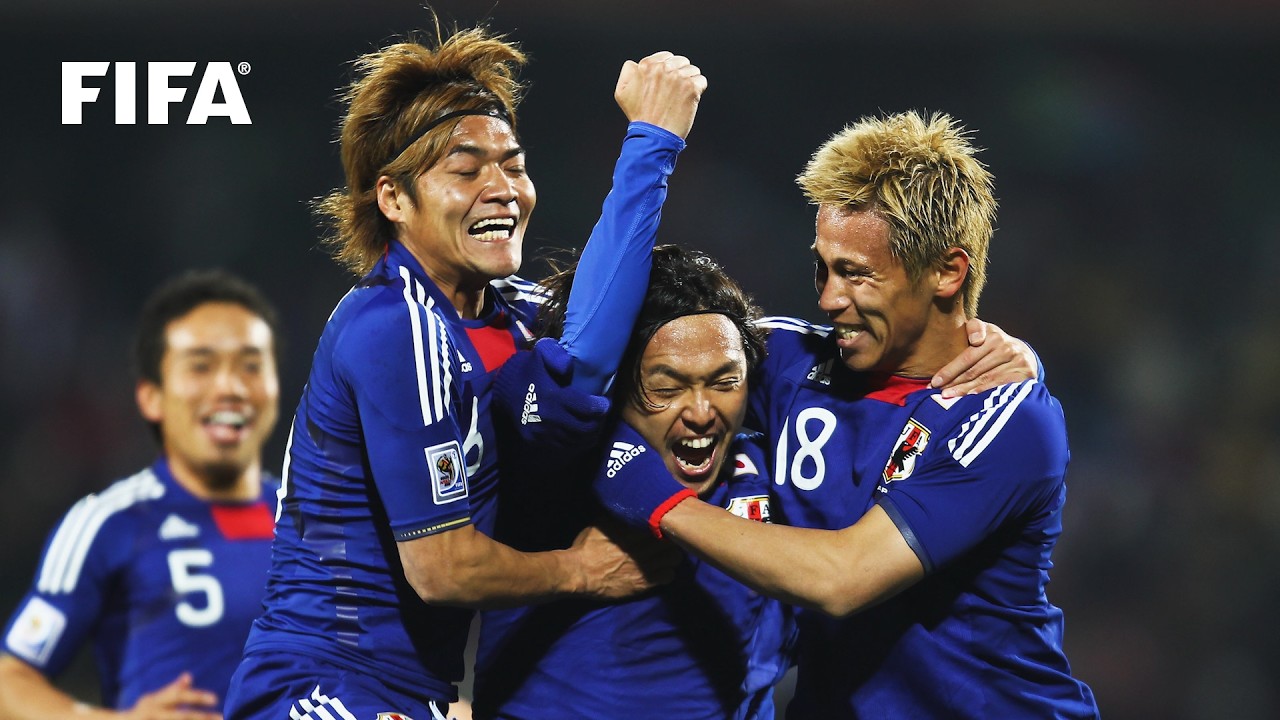
The 2010 World Cup in South Africa marked the pinnacle of Japan’s golden generation, characterized by tactical discipline and lethal transition play under coach Takeshi Okada. It was also the tournament where Keisuke Honda truly announced himself to the world. Celebrating his 24th birthday, Honda scored the crucial match-winner against Cameroon in the group opener, latching onto a brilliant, deep cross from Daisuke Matsui to steer the ball home at the far post.
The Free-Kick Clinic Against Denmark
Perhaps no match in Japanese football history is as legendary as their final group-stage encounter against Denmark in Rustenburg. Needing a result to qualify for the Round of 16, Japan put on a world-class display of set-piece artistry that left Danish goalkeeper Thomas Sørensen utterly bewildered:
- The Honda Rocket: From nearly 30 yards out, Keisuke Honda struck a knuckleball free-kick with the outside of his boot. The ball defied physics, dipping and swerving violently past Sørensen to give Japan the lead. It remains one of the most iconic free-kicks in World Cup history.
- The Endo Curler: Just minutes later, Japan won another free-kick in a dangerous area. While Denmark prepared for another Honda blast, it was Yasuhito Endo who stepped up, curling an exquisite, delicate strike around the wall and into the side netting.
- The Okazaki Clincher: To seal the 3-1 victory and secure a place in the knockout rounds, Honda turned provider. After a dazzling piece of footwork in the penalty area that drew the keeper out, he unselfishly squared the ball to Shinji Okazaki, who tapped it in to send the nation into raptures.

The Enduring Legacy
The era stretching from 1998 to 2010 transformed Japan from Asian contenders into respected global competitors. The brilliant individual performances of Nakata, Nakamura, Endo, and Honda established a culture of tactical intelligence, technical excellence, and relentless determination. Today, as Japanese players continue to dominate major European leagues, they build upon the foundation laid by these pioneers who proved that with discipline and artistry, the Samurai Blue could conquer any stage.