
Introduction: The Rollercoaster Era of English Football (1998-2014)
Between 1998 and 2014, the England National Football Team experienced a dramatic saga filled with world-class talent, iconic moments, and agonizing tournament exits. Dubbed the ‘Golden Generation’ for much of this period, the squad boasted some of the finest individual talents in world football, including David Beckham, Steven Gerrard, Paul Scholes, Michael Owen, and Wayne Rooney. Despite tactical challenges and systemic bottlenecks, this era produced some of the most memorable and visually spectacular goals in World Cup history.
In this deep dive, we break down the iconic strikes, the tactical playmaking, and the individual brilliance that defined England’s international campaigns from France ’98 to Brazil 2014.
France ’98: The Dawn of a New Era
Shearer’s Leadership and Scholes’ Precision
The 1998 World Cup in France marked a transition of power in English football. Alan Shearer, wearing the captain’s armband, established England’s physical presence early. Supported by pinpoint deliveries from the flanks—such as Graeme Le Saux’s dangerous crossing—Shearer’s aerial prowess was a constant threat. Against Tunisia, Shearer did what he did best, rising above the defense to slot home an opening goal that settled English nerves.
But it was the midfield dynamism of Paul Scholes that truly signaled a new tactical dimension. In the dying moments of the same match, after brilliant buildup play from Paul Ince, Scholes collected the ball on the edge of the box. Showing immense poise, he curled a magnificent right-footed strike past the goalkeeper to seal a 2-0 victory, showcasing the clinical transition play that would make him a Manchester United legend.
Michael Owen’s Masterpiece Against Argentina
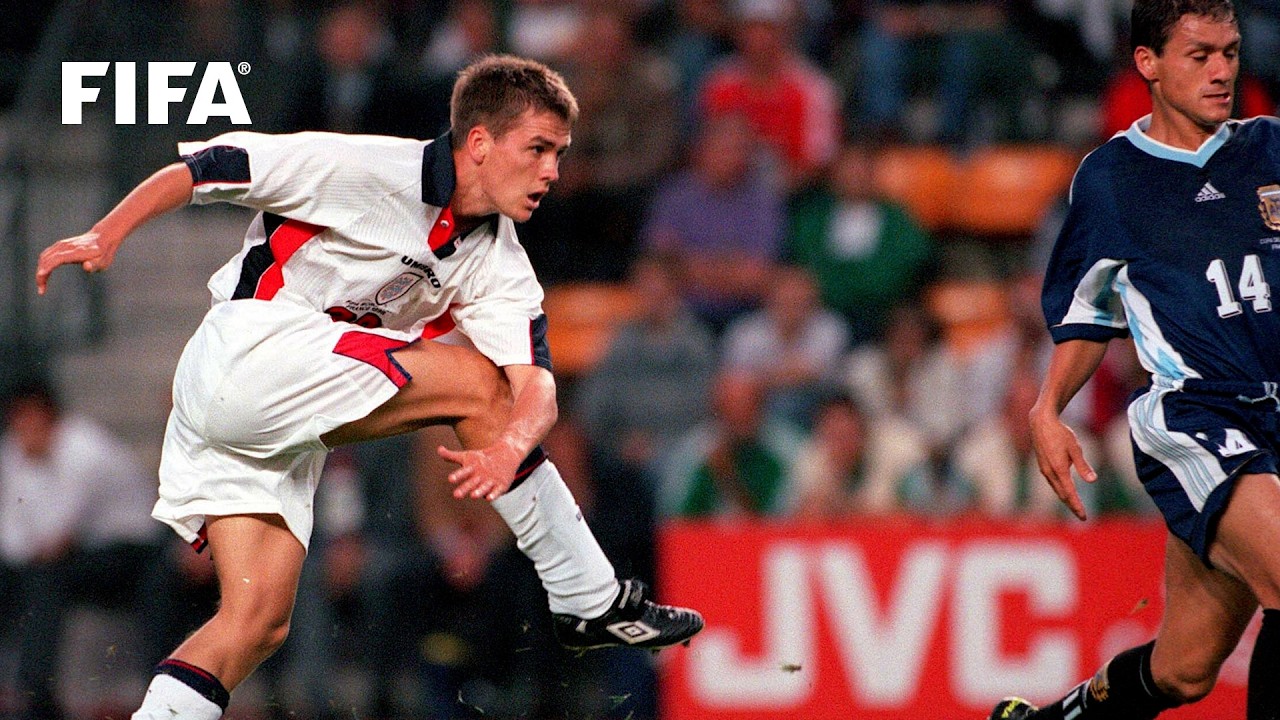
The Round of 16 clash against Argentina in Saint-Étienne remains one of the most pulsating matches in World Cup history. After Alan Shearer neutralized Gabriel Batistuta’s early penalty with a clinical penalty of his own past Carlos Roa, the stage was set for an 18-year-old Michael Owen to write his name into football folklore.
Receiving a pass from David Beckham near the halfway line, Owen used his electrifying pace to tear past the Argentinian midfield. Confronted by veteran defender Roberto Ayala, Owen executed a brilliant body feint, shifting the ball to his right before lifting a sublime finish into the top corner. It was a goal of pure instinct, power, and unbelievable composure for a teenager, instantly catapulting Owen to global superstardom.
Germany 2006: Beckham’s Precision and Midfield Magic
The Deadly Beckham-Crouch Connection
By 2006, England’s offensive strategy heavily revolved around the elite delivery of David Beckham. In the opening group match against Paraguay, it was a wicked, whipped Beckham free kick that forced a Paraguayan defender to head the ball into his own net, securing a crucial 1-0 win.
This dynamic was perfected later in the tournament against Trinidad & Tobago. With England struggling to break down a stubborn defense, Beckham drifted wide and delivered an absolute peach of a cross to the back post. Standing at 6’7″, Peter Crouch used his massive height advantage to rise above his marker and head home, breaking the deadlock and highlighting the tactical utility of having ‘the big man’ upfront.
Wonder Goals: Joe Cole and Steven Gerrard
The group stage match against Sweden in 2006 showcased the sheer individual quality of England’s midfielders. Joe Cole scored what many consider the goal of the tournament. Intercepting a clearance deep in the Swedish half, Cole chest-controlled the ball and, from nearly 35 yards out, unleashed a looping, dipping volley that sailed over Andreas Isakson and into the top corner.
Steven Gerrard added to the spectacular reel, scoring signature long-range efforts. Against Trinidad & Tobago, he cut inside to launch a ferocious left-footed drive into the side netting. He repeated his goal-scoring heroics against Sweden, meeting a beautiful cross from Joe Cole to head past the keeper, proving why he was one of the most complete midfielders of his generation.
To seal their progress to the quarterfinals, David Beckham once again delivered when it mattered most. Against Ecuador, he stood over a free-kick from 30 yards out, striking it with trademark whip and bend to beat Christian Mora at his near post, demonstrating that world-class set-pieces can decide tight international knockouts.
South Africa 2010: Frustration and Flashpoints
The 2010 World Cup in South Africa was a challenging campaign for Fabio Capello’s side, yet it started with early promise. In the opening match against the United States, Steven Gerrard took a captain’s lead. After a slick, quick throw-in and a clever touch from Emil Heskey, Gerrard ghosted into the box and poked the ball past Tim Howard to give England an early lead.
When qualification hung in the balance against Slovenia, it was James Milner’s pinpoint cross from the right wing that unlocked the defense, allowing Jermain Defoe to make a darting run across his marker and smash home a vital winner.
The tournament ended in controversy and defeat against Germany in the Round of 16, but not before Matthew Upson briefly gave England hope, heading home a crucial set-piece delivery to make it 2-1 before tactical breakdowns cost England the match.
Brazil 2014: Passing the Torch
By 2014, the Golden Generation was winding down, making way for a younger, pacier crop of players like Raheem Sterling and Daniel Sturridge. In their opening clash against Italy in the humid Amazon rainforest, Sterling unlocked the Italian defense with a sensational pass to Wayne Rooney on the wing. Rooney looked up and delivered a exquisite, low cross to the back post, where Daniel Sturridge met it with a high-quality finish to level the score.
In the following match against Uruguay, Wayne Rooney finally broke his World Cup finals hoodoo. After brilliant wing play from Glen Johnson, who beat Diego Godín to squeeze a cross through the box, Rooney made a perfectly timed run to tap the ball home at the back post, marking his historic 40th international goal.
Conclusion: The Legacy of England’s Golden Era
While the 1998-2014 era did not yield the international silverware English fans desperately craved, it left behind a rich tapestry of unforgettable goals. These moments highlight a unique era of English football—one characterized by extraordinary individual quality, iconic set-piece mastery, and some of the most dramatic spectacles in modern sports history.